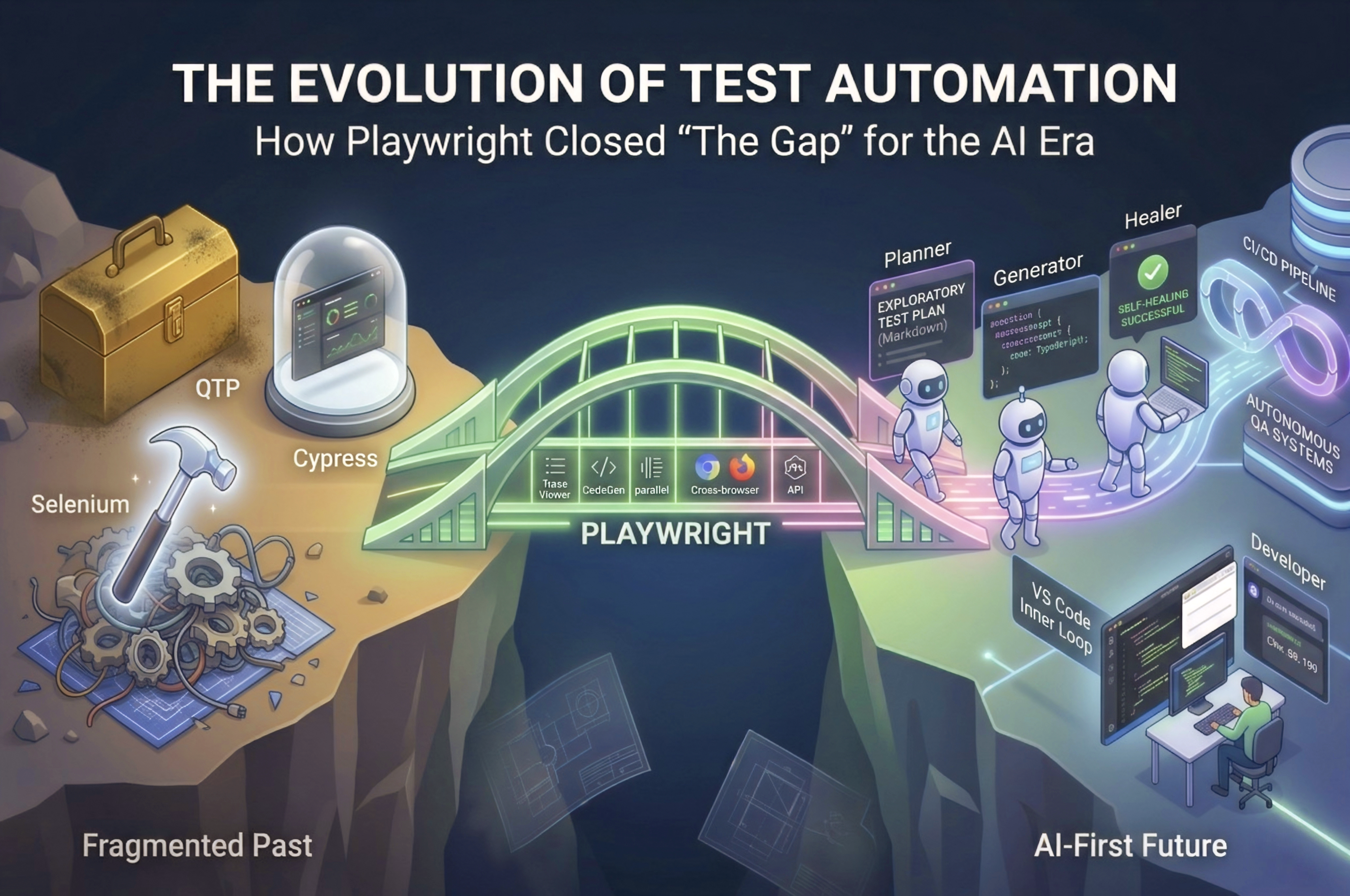
I started my test automation career over 20 years ago. I've seen tools rise, tools fall, and entire paradigms shift. And after all these years, I've figured out the single truth that explains why every major tool won or lost.
It was never about being better. It was always about filling the gap.
The Golden Age Nobody Talks About
Before 2010, test automation was actually quite mature in terms of developer experience. Tools like QTP gave you everything in one place — a rich GUI, smart element identification, built-in recovery mechanisms that could handle failures and continue the same test execution, detailed reporting, and a complete workflow from writing tests to reading results.
Yes, they were commercial. Yes, they were expensive. But they were complete.
Then the open-source wave hit.
Selenium: The Trade-Off We Accepted
Selenium changed everything — but not entirely for the better.
Suddenly, browser automation was free. More importantly, Selenium Grid introduced something no commercial tool had ever done well: parallel, distributed, remote execution. You could run thousands of tests across browsers and machines simultaneously. The feedback loop that used to take hours now took minutes.
For test execution, we leapt forward by a decade.
For test development, we quietly went backwards.
Selenium automates a browser. That's it. Full stop. Need a test framework? Add one. Need reporting? Find a library. Each one is a separate integration, a separate dependency, a separate thing that can break.
We traded a complete toolbox for a single hammer — and called it progress because the hammer was free.
We gained something QTP could never give us — scale, flexibility, and freedom from vendor lock-in. But we traded away the integrated developer experience that made testing feel complete. It wasn't a mistake. It was a trade-off. And for years, it was worth it. Until it wasn't.
"Selenium automates browsers. That's it." — selenium.dev/about
2017: Cypress Asks the Question Nobody Was Asking
For years, nothing truly groundbreaking happened in test automation. Selenium got better at its one job. The ecosystem of add-on libraries grew. And we got used to the complexity.
Then Cypress arrived in 2017 and asked a dangerous question: What if we just built everything together?
Browser automation. API testing. Component testing. A built-in test framework. Results dashboard. Developer tooling integration. Cypress looked at what we'd been assembling from 10 pieces and said — what if it was one?
For many teams, it felt like the future had arrived.
But Cypress carried a fundamental architectural constraint: it runs inside the browser. That's how it achieved its tight integration and developer experience. But it also meant you couldn't use it for general-purpose automation, couldn't go outside the browser context, couldn't work across multiple browser origins easily.
Cypress filled part of the gap. But it created a new one.
Google Builds Puppeteer. The Gap Remains.
Google saw the browser automation space and built Puppeteer — deep Chrome integration, fast, modern. It was a significant technical achievement. But it was, at its core, another automation library. Not a framework. Not an end-to-end solution.
The gap wasn't closed. It was redefined.
The Puppeteer Team Goes to Microsoft. Playwright Is Born.
Here's where the story gets interesting.
The team that built Puppeteer moved to Microsoft and created Playwright. Initially, it looked like a more capable Selenium — cross-browser automation, API testing, better architecture. Impressive, but familiar.
"Playwright was created by the same engineering team that built Puppeteer." — Checkly Docs
Microsoft had built a powerful automation library. Cross-browser. Fast. Modern. But the gap — the one around developer experience, integrated framework, and complete test workflow — was still there.
Microsoft's First Attempt: Folio
To their credit, Microsoft saw the gap and tried to address it.
Before Playwright Test existed, Microsoft created a separate test framework called Folio and asked Playwright users to adopt it alongside Playwright to get the testing experience they needed.
The idea was right. The execution was incomplete.
Folio was a customizable framework that let you build your own test infrastructure on top of it. Technically interesting, but it asked too much from the user — you had to wire two separate tools together, manage two separate dependencies, and hope they stayed compatible. It was still the Selenium problem with better branding.
The engineering community didn't fully embrace it. Microsoft listened.
The Folio repository was eventually archived in 2022. Its README says it all:
"Folio has been merged into Playwright Test." — github.com/microsoft/folio
This is actually a powerful signal. Microsoft tried the "separate library" approach, found it wasn't enough, and made the hard decision to fold everything into one. That kind of self-correction is rare — and it's exactly what separates tools that evolve from tools that stagnate.
The Moment Everything Changed
Microsoft made the decision that defined Playwright's future: they built Playwright Test — a test framework tightly integrated into Playwright itself. Not a separate library. Not a recommended companion. Built in. Shipped together. Maintained together.
Suddenly you had, in a single installation:
- Cross-browser automation (Chromium, Firefox, WebKit)
- API testing
- Component testing
- Built-in test runner with parallelism
- Trace viewer for debugging
- Screenshot and video capture
- Retry logic
- HTML reporting
- CI/CD friendly configuration
For the first time since the QTP era, test automation felt complete again — but now with the execution power that Selenium had pioneered. The best of both worlds, finally in one place.
The gap closed.
Then GenAI Arrived. A New Gap Formed.
Just as Playwright reached maturity, the entire software industry shifted. AI entered development workflows. Agents started writing, running, and analyzing code. The question became: how does test automation fit into an AI-first world?
Playwright didn't wait for someone else to answer that question.
MCP (Model Context Protocol) support. AI agent integration. VS Code co-pilot workflows. Playwright positioned itself not just as a testing tool but as the testing layer for agentic software development. It embedded itself into the places where modern development actually happens.
"With the recent integration of Playwright MCP and the Playwright MCP server included in GitHub Copilot's Coding Agent, AI-assisted development is now a reality." — Microsoft for Developers Blog
Playwright now ships three AI agents out of the box:
- 🎭 Planner — explores your app and produces a Markdown test plan
- 🎭 Generator — converts the plan into executable Playwright tests
- 🎭 Healer — runs the tests and automatically repairs failures
This is not a small thing. Most tools wait to see where the industry goes and then follow. Playwright moved with the wave, sometimes ahead of it.
The gap that GenAI created? Playwright is filling it in real time.
For a deep technical breakdown of Playwright's AI evolution — from deterministic automation through MCP to the Playwright 1.59 trust and observability layer — read the full analysis on the VibeTestQ blog:
Playwright 1.59 + VS Code: The Evolution of AI-Driven Testing from Automation to Autonomous Exploration
On the New Challengers
Tools like Vibium are emerging, positioning themselves as browser automation built natively for AI agents. Vibium deserves a fair look — it is built by Jason Huggins, the original creator of Selenium. If anyone understands what a gap looks like before the rest of the industry sees it, it is him.
Vibium is technically interesting — built on WebDriver BiDi, lightweight, with a CLI skill interface genuinely designed for agent workflows. The roadmap points toward AI-powered locators, a memory and navigation intelligence layer, and a distributed device network. The ambition is real.
But today, it is still a browser automation library. No built-in test runner. No assertions. No reporting. No integrated test framework. Sound familiar? This is the same starting point every generation begins with — Selenium in 2004, Puppeteer in 2017. The automation primitive always comes first. The framework problem always comes second.
The fact that even Jason Huggins is starting from the automation layer highlights a familiar pattern: the execution primitive comes first. Whether it evolves into a complete solution is the part that history ultimately judges.
The real question remains: what gap does Vibium fill that Playwright isn't already filling — or actively building toward? Playwright already has MCP, CLI skills mode, AI agents, VS Code integration, and a complete test framework underneath it all.
If Vibium's roadmap matures into something that fills a gap Playwright leaves open, it's worth watching closely. And consider this: if Jason Huggins — the person who created Selenium — can see a gap forming, does anyone believe Microsoft, with a dedicated team, enterprise resources, and deep VS Code integration, cannot see the same gap? The difference is what they can do about it. We already witnessed what Microsoft did to the IDE market with VS Code. Atom, Sublime, even established players didn't see it coming at that scale. The same institutional force is now behind Playwright. That is a difficult position for any third-party player to compete against.
The pattern holds: the history of test automation belongs to whoever builds the complete solution, not just the best primitive.
The Next Gap Is Already Forming
The next gap is already forming — and it is not in tools. It is in autonomous reasoning about testing.
The future is not about writing better test scripts or even generating them with AI. It is about systems that can understand what to test, why it matters, how to adapt when behavior changes, and how to validate outcomes with context. This is not a framework problem. It is an intelligence problem.
Tools like Playwright have already stabilized the execution layer and built the necessary infrastructure to integrate seamlessly with AI-driven development environments. As of April 2026, there is still time before this next shift fully materializes — the current gap around AI orchestration is itself still evolving. But that is precisely how every transition begins: the gap appears before the solution takes shape.
Until then, Playwright remains the leading foundation. Learning it alongside AI integration is the most practical way to stay relevant in the AI-driven era of testing.
What 20+ Years Taught Me
I started in this field with WinRunner and QTP. I learned Selenium when it disrupted everything. I watched Cypress raise the bar. And in 2020, in Playwright's early days — before the ecosystem caught up, before the LinkedIn posts and conference talks — I saw what it was becoming.
I was among the first to deliver Playwright training in 2020 using Mocha test framework to engineers at L&T. Not because I was following a trend. Because I understood the gap Playwright was closing was real, and the team building it was serious about closing it completely.
Today, Playwright isn't just a test automation tool. It's the test framework for the AI era — the testing infrastructure layer for modern software development, including agentic systems.
If you're a QA engineer, developer, or team lead who wants to stop patching together libraries and start building serious, future-proof test infrastructure, Playwright is where you need to be. And the fastest way to get there is to learn from someone who has been doing this for over 20 years — who saw Playwright's potential before most people had heard of it.
That foundation is what I teach at VibeTestQ — and it is exactly what prepares you for the shift that is coming next.
Sudhakar Kakunuri — known globally as QTPSudhakar — is a Quality Engineering Leader with 20+ years of experience across QTP, Selenium, and Playwright. He is the founder of VibeTestQ, with 10,000+ students trained and 200+ corporate training engagements worldwide.
🎯 Ready to master Playwright — including MCP, AI agents, and the full modern testing stack?
Join the live training programs at VibeTestQ:
- Playwright with GenAI → vibetestq.com/qa-ai-era-training
- All Programs → vibetestq.com/training
- Mock Interview Prep → vibetestq.com/interviews
- About Sudhakar → vibetestq.com/about
📚 Reference Links
VibeTestQ
| Resource | Link |
|---|---|
| About VibeTestQ & Sudhakar Kakunuri | https://vibetestq.com/about |
| Playwright with GenAI Training Program | https://vibetestq.com/qa-ai-era-training |
| All Training Programs | https://vibetestq.com/training |
| Mock Interview Preparation | https://vibetestq.com/interviews |
| Blog: Playwright 1.59 + VS Code — AI-Driven Testing Evolution | https://vibetestq.com/blogs/playwright-1-59-vscode-ai-driven-testing |
Playwright — Official Resources
| Resource | Link |
|---|---|
| Playwright Official Site | https://playwright.dev |
| Playwright GitHub Repository | https://github.com/microsoft/playwright |
| Getting Started — Playwright Test | https://playwright.dev/docs/intro |
| Playwright Test Agents Documentation | https://playwright.dev/docs/test-agents |
| Playwright MCP Documentation | https://playwright.dev/docs/mcp |
| Playwright MCP GitHub Repository | https://github.com/microsoft/playwright-mcp |
| Playwright MCP Videos (Official) | https://playwright.dev/community/mcp-videos |
| Microsoft Azure Playwright Testing | https://learn.microsoft.com/en-us/azure/playwright-testing/ |
Folio — Microsoft's Stepping Stone Before Playwright Test
| Resource | Link |
|---|---|
| Microsoft Folio — Archived GitHub Repository | https://github.com/microsoft/folio |
Vibium
| Resource | Link |
|---|---|
| Vibium — GitHub Repository | https://github.com/VibiumDev/vibium |
Selenium
| Resource | Link |
|---|---|
| Selenium Official Site | https://www.selenium.dev |
| Selenium History (Official) | https://www.selenium.dev/history/ |
| About Selenium | https://www.selenium.dev/about/ |
| Selenium — Wikipedia | https://en.wikipedia.org/wiki/Selenium_(software) |
| History of Selenium — Sauce Labs | https://saucelabs.com/resources/blog/a-brief-history-of-the-selenium-testing-framework |
Cypress
| Resource | Link |
|---|---|
| Cypress Trade-offs — Official Documentation | https://docs.cypress.io/app/references/trade-offs |
| Cypress Cross-Origin Testing — Official Documentation | https://docs.cypress.io/app/guides/cross-origin-testing |
Further Reading
| Resource | Link |
|---|---|
| What Is Playwright — Checkly Docs | https://www.checklyhq.com/docs/learn/playwright/what-is-playwright/ |
| Microsoft Dev Blog: The Complete Playwright Story | https://developer.microsoft.com/blog/the-complete-playwright-end-to-end-story-tools-ai-and-real-world-workflows |
| Playwright Tutorial — BrowserStack | https://www.browserstack.com/guide/playwright-tutorial |
#Playwright #TestAutomation #QA #SoftwareTesting #VibeTestQ #AITesting #MCPServer #AgenticTesting #QTPSudhakar